What does Early Maths REALLY look like for young children?
Roots and Wings – Helping Children “Fly” – Mathematically Speaking!
They say that a parent’s job is to give children “roots and wings”.
Roots are those firm foundations of attachment and emotional security, self-esteem and confidence that provide children the solid bedrock from which they can “jump off” into life.
Wings represent the journey out into the world – to discover and explore, investigate and examine the joyful, rich possibilities – full of such interesting people and places, ideas and experiences!
But what if we think about just one aspect of learning – Maths.
Yuck!
Maths often brings up anxiety or worry or it just doesn’t feel natural or intuitive.
But what if Maths has “roots” that offer a strong sense of confidence and capability, curiosity and delight?
But what if Early Maths experiences give children the “wings” to fly – mathematically speaking!
Well, there are fundamental experiences that children naturally and intuitively engage with from the very start.
There are mathematical concepts that children engage with in a very fundamental way that offer them “anchors” – strong fixings which enable them to develop essential mathematical knowledge, skills and understanding.
Anchors – How do We Help Children feel Strong and Secure in Early Maths
The Erikson Maths Collaborative – a group of American educators and researchers – have found there are fundamental precursors to later mathematical success.
They say,
“… in the first three years of life children engage in a very fundamental way with concepts that anchor a child’s mathematical thinking and are essential for the growth of further mathematics”
The Erikson Maths Collaborative talk about 4 key concepts that the very youngest children are developing – and need to be supported in developing :
- Attributes – seeing and noticing the properties or qualities that allow us to describe and classify the world around us
- Comparison – is noticing and talking about sameness and difference
- Pattern – involves looking out for the rhythm, sequence and regularity that allows for prediction
- Change – means exploring things that become different – things that “transforms”
Seeing and Noticing – Attributes
Noticing is all about talking.
Talking about what you see.
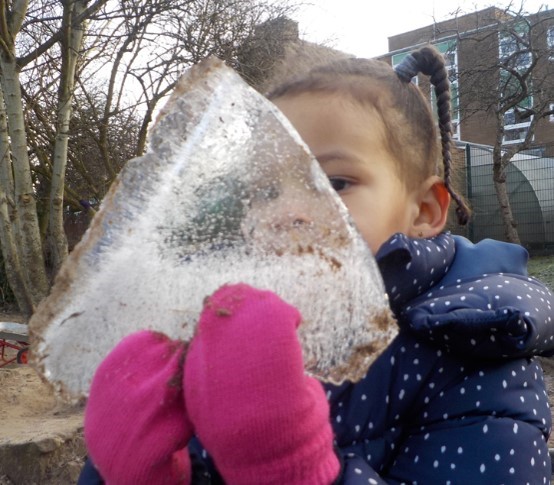
What is it you see in the sheet of ice?
It is cold and slippy, freezing or melting.
It has lines or dots or spots or angles or curves or colour.
It has properties and attributes – qualities that we can notice and talk about.
Helping children notice the properties and attributes of all objects in their world – natural or made, familiar or novel, similar or different – is an essential aspect of early maths.
Seeing and noticing ATTRIBUTES is firm foundation of early maths!
What is the Same, What is Different – Comparison Conversations
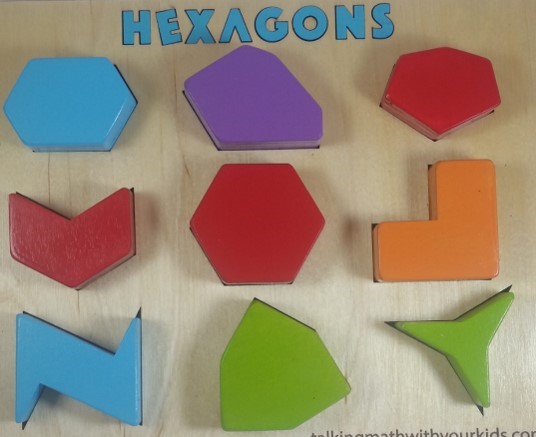
Have a look at the picture below.
They are all hexagons – six-sided shapes.
What is the same?
What is different?
Talking about sameness and differences – comparison conversations – is essential to developing mathematical minds.
What in your house or on your way home would lend itself to talking about similarities and differences?
Differences come in all sorts of shape and sizes don’t they – size, length, height, weight, colour, quantity, shape – and not forgetting taste and texture!
You might be at home tasting things that are sweet or sour, finding textures and materials that are rough or smooth, straight or curved.
Or when putting on shoes there a lots differences in size, material, colour, shape, laces or Velcro!
Or in the street seeing cars and vehicles of all sorts of sizes, shapes, purposes.
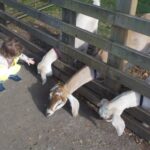
Or you might even spot some insects or animals – we found hundreds of ladybirds last summer and were delighted in talking about spots and wings and colour and ‘type of ladybird’ (apparently 26 types in the UK)!
When you start “spotting” differences and making comparisons, once you start noticing and talking – mathematically speaking – then you are playfully securing your child’s firm foundations in early maths.
Pattern Power – Patterns in Nature, Patterns in Made Objects
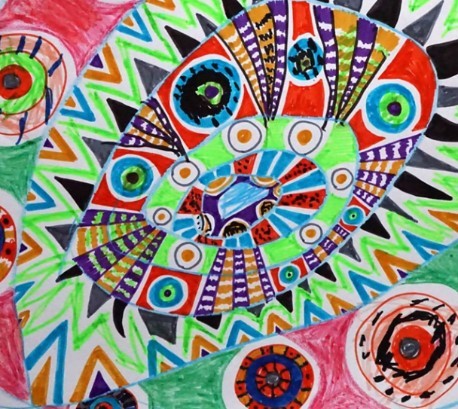
Patterns are everywhere!
You don’t have to go that far to see them!
But looking – and talking about them – is essential!
Sue Gifford – an Early Maths expert – says “children who expect maths to “make sense” look for patterns.
Sue and other researchers say that “pattern expertise” predicts later mathematical success and outcomes!
So patterns are pretty important.
There are all sorts of patterns aren’t there.
You can see patterns everywhere – on tiles and wallpaper and signs and pictures, on dice and dominoes.
You can hear patterns – in music, clocks ticking, footsteps.
You can feel patterns – in dance and walking and moving.
There are patterns in the day, the week, the season – patterns of time.
You can spot patterns in number too – when you count, using fingers, adding 1 more.
Directly teaching children pattern-awareness will help them spot, describe, change and see irregularities in patterns.
Children should be encouraged to verbalise and talk about the patterns they notice.
“I see a blue, red, blue, red pattern…”, they might say.
“I see the pattern like 5 on a dice…”, they might say.
“I’m eating apple, pear, apple, pear, apple, pear…”, they might say.
“I hear a chicken, banana, chicken, banana, chicken, banana pattern…” they might sing – as you listen to that gloriously irritating but catchy song!
Transformations! Things that Change (and Change Back Again!)
What happens when you eat slices of the cake?
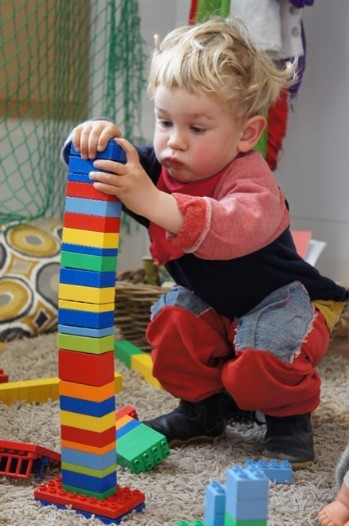
What happens when you build a tower or knock it down?
What happens when you mix ingredients or fold a piece of paper?
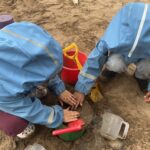
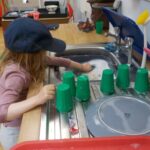
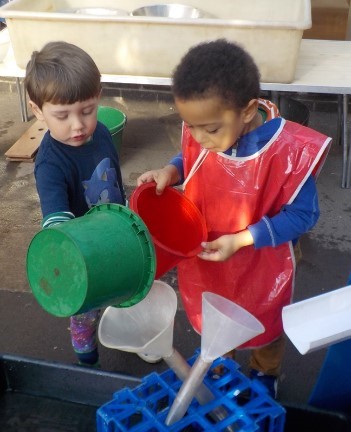
What happens when you fill or empty a bucket?
What happens when you rotate a shape or move a jigsaw piece into place?
They change and transform!
Sometimes the change is about size or shape or quantity – getting larger, smaller, different.
Sometimes the change is about perspective and the way things look – flatter, narrower, shorter!
What will you need to do to change it back again?
You will need to transform or change it again!
What the object looked like before and after it had been changed – subtracted from ( the cake ), pushed over ( the tower ) or folded over ( the paper ) – must be recognised and talked about.
Change means exploring things that become different – things that “transform” – and is an essential ingredient in children’s mathematical development.
Up! Up! And Away!
So helping children “fly” – mathematically speaking – is about “anchoring” them through mathematically noticing, talking and thinking together.
It’s about looking closely at things – talking about their attributes then comparing and contrasting them.
It’s about seeing the patterns in them – looking for regularities, repetitions and how they relate to one another.
And it’s about how these things can be changed and transformed by joining, separating, emptying, filling or mixing.
There are mathematical moments everywhere!
And if we capitalise on them – through the ‘lens’ of attributes, comparison, pattern and change – then we are giving children that really firm foundation in Early maths.
From there they can be catapulted into confident, capable, curious mathematicians!